Culture
The quiet revolution at 8 a.m.
Bike-to-work days began as advocacy stunts and became civic institutions. This is the story of how the commute by bike turned from eccentricity to movement — and what the morning bike lane looks like around the world today.
An idea with many birthdays
No single person invented the bike-to-work day; it kept being reinvented wherever traffic got bad enough. In the United States, the League of American Bicyclists grew National Bike Month through the spring decades, with Bike to Work Week and a signature Bike to Work Day in May — the campaigns that put mayors on bicycles and free breakfast tables at city corners. Britain's Cycle to Work Day and the tax-sheltered Cycle to Work scheme that preceded it made the commute a policy instrument; continental Europe folded the same energy into European Mobility Week each September, when cities hand streets to bikes for a day and some never take them back. The through-line is a century old and simple: the bicycle is the most efficient commuter machine ever built, and the twentieth century simply forgot to price it.
The Dutch warning from history
Every culture page about commuting owes the founding story. In the 1950s and 60s the Netherlands motorised as fast as anyone — roads widened, casualties climbed, and by the early 1970s traffic was killing hundreds of children a year. The response, Stop de Kindermoord, was parents' grief converted into policy: mass cycling protests, white bikes, and a government that rebuilt streets around the assumption that a trip to school should not cost a life. Half a century later the Dutch commute is the world's proof of concept — a quarter of all trips by bike, riders in ordinary clothes on ordinary bikes, and a traffic-fatality rate the envy of the planet. The lesson exports imperfectly but exports: infrastructure follows demand, and demand is built one nervous new commuter at a time. Every guide on this site — gear, routes, weather — exists to lower the cost of becoming that commuter.
The morning bike lane as sociology
Look at a protected lane at 8:15 in a mature cycling city and you see something no car culture has: diversity of the trip. Schoolchildren in bunches, delivery riders on e-cargo, executives in suits overtaken by nurses in scrubs, grandparents on upright frames with grandchildren in front boxes. The Dutch call the mainstream city bike the omafiets — grandma bike — and the name is the point: when a transport mode belongs to grandmothers, it has finished its revolution. The status hierarchy of the road inverts too. In car cities the cyclist is a costumed outsider; in bike cities the driver is the one negotiating a world not built for them. Culture, it turns out, is infrastructure plus time.
Bike buses and the newest commuters
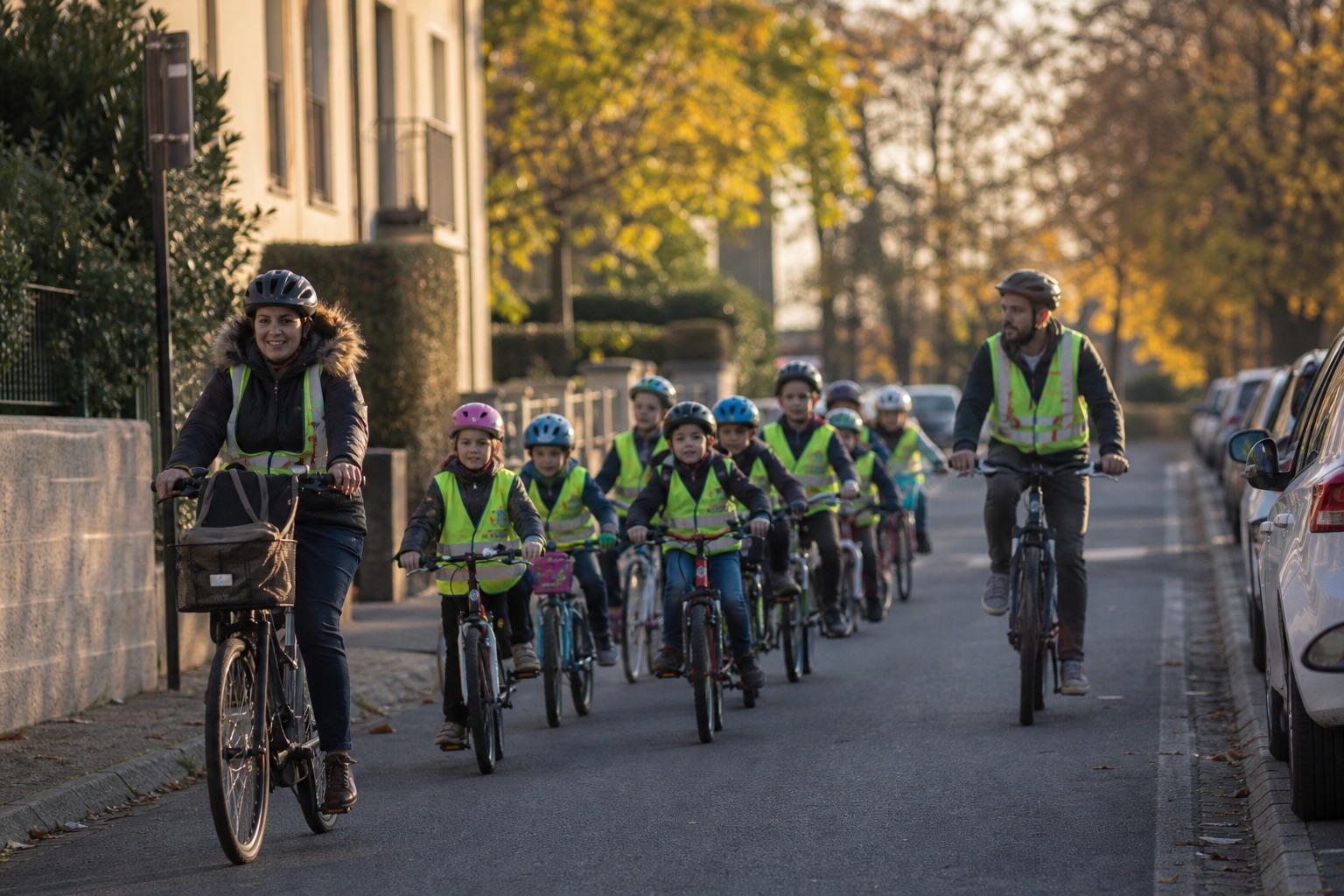
The movement's freshest institution is the bike bus — a volunteer-led walking-bus-of-bicycles that scoops up children street by street and pedals them to school in a convoy too big to ignore. Started in Porto, viral everywhere, the bike bus is simultaneously childcare, exercise, driving-instruction and rolling protest: city councils now schedule meetings around them. Parents who build bike buses tend to become the next wave of advocacy leaders, because a morning spent marshalling eight-year-olds across a junction teaches more street design than a planning degree. Cargo bikes deserve their share of the same chapter — the family bike that replaced the second car, the tradesperson's van-replacement, the school-run peloton. Half of urban car trips are under five kilometres; the cargo bike eats that distance for breakfast.
The workplace as movement engine
Culture scales through employers. The classic lever is the mileage challenge — log your commutes, win nothing but glory and a T-shirt, arrive transformed — and the modern one is the tax benefit, from Britain's salary-sacrifice scheme to Belgium's cycling allowance per kilometre. Serious programs add the hardware of normality: covered parking, showers, repair stands, a pump. We keep a full playbook in the employer's guide, because the data is consistent — workplaces that make commuting by bike boringly easy get healthier staff, lower parking bills and a recruitment story that writes itself.
Where the magazine stands
Bike2Work Day is published for riders, not for any single campaign — but we are unashamedly on the side of the movement: every commute logged is a vote for quieter, safer, saner streets. If you are new, the fastest immersion is our own Commute Challenge, and the gallery collects the view from the saddle in words. For the campaigns, organisations and mapping tools worth your bookmarks, the resources page is the short list. The revolution, as always, leaves on time tomorrow morning — and there is a space in the lane with your name on it.