Health & fitness
Two half hours, hidden in plain sight
The commute you had to make anyway is the most reliable exercise program ever devised. Here is what the daily ride actually does to your heart, your head and your back — and how to keep it doing good for decades.
What thirty minutes, twice a day, adds up to
Public-health guidelines ask for 150 minutes of moderate activity a week. A bike commuter with a twenty-five-minute ride each way clocks fifty minutes a day, five days a week — 250 minutes, done before most people have found their gym kit. And unlike gym resolutions, commutes have perfect adherence, because the meeting is at nine whether you pedal or not. Large cohort studies have followed commuters for years and keep finding the same pattern: cycle commuters show lower rates of cardiovascular disease and type-2 diabetes, and typically arrive with better cardiometabolic numbers than colleagues who drive, even after accounting for income and smoking. The effect size is not miraculous — it is the compound interest of an ordinary ride, repeated thousands of times.
The head arrives first
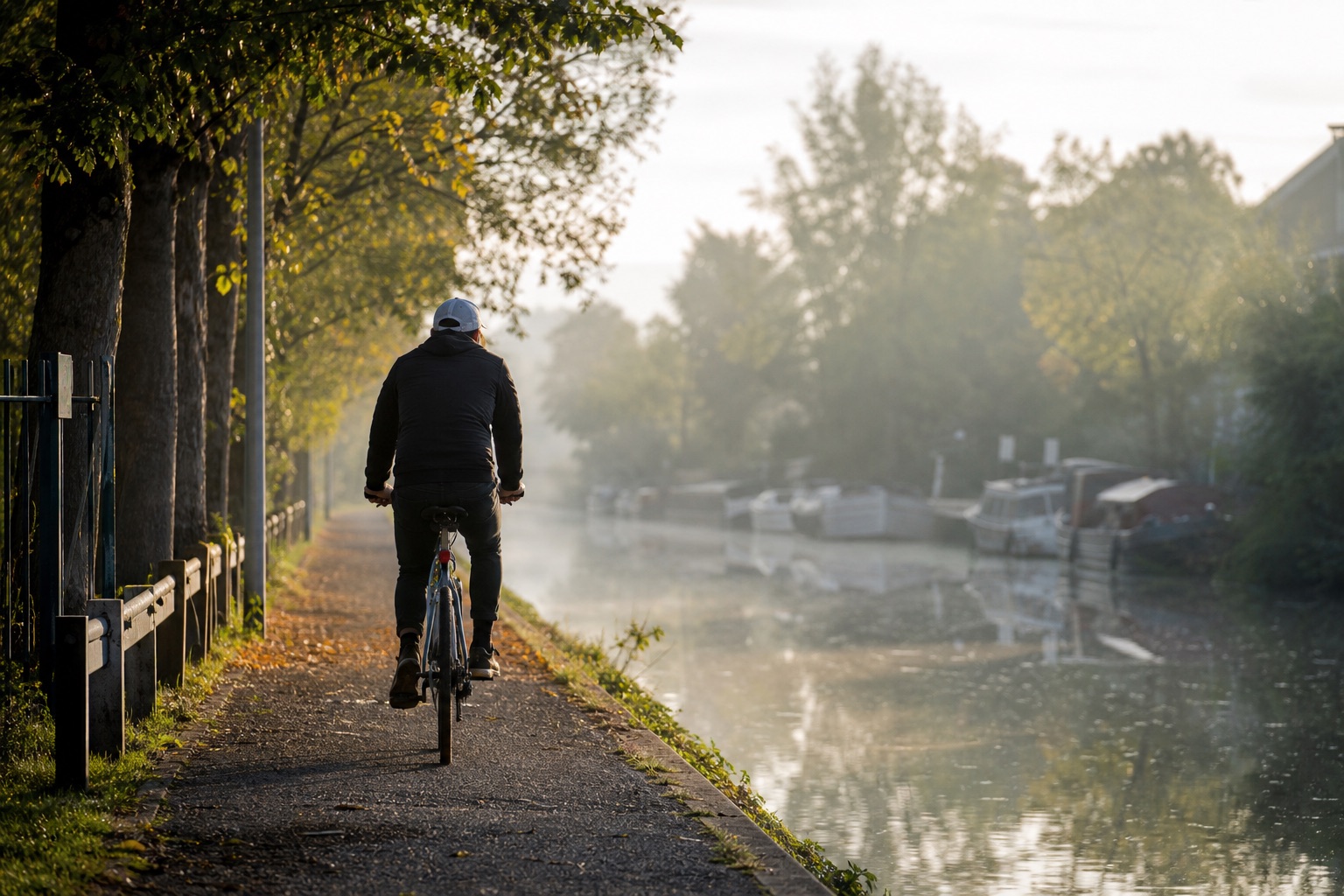
Ask long-term bike commuters why they ride and few mention fitness first; they talk about the head. The evidence backs the anecdote: active commuters consistently report lower stress and higher wellbeing than drivers, and the effect is strongest on the ride home, which functions as a decompression chamber between work and family. The mechanism is unglamorous — rhythmic effort, daylight, mild novelty — but the result is real: the working day acquires a clean boundary on both sides. People who struggle to sleep often find a dark-morning or evening ride resets their rhythm faster than supplements, because daylight is the strongest signal the body clock receives. If your commute is currently a traffic report, this alone is worth the switch; our route guide will make the ride calm enough to enjoy it.
Intensity: the honest middle
Commuting is zone 2 exercise — conversational effort, warm breath, light sweat — and zone 2 is precisely where health agencies want the population. There is no need to race the bus, and good reasons not to: arriving drenched defeats the purpose if there are no showers, and intensity you dread is intensity you quit. Ride easy enough to hold a sentence in your head, hard enough to feel the lungs in the first five minutes. Riders who want more can add intervals on the way home — the classic is eight hard lamp-posts, easy lamp-post between — turning the commute into genuine training without touching a gym. Chasing structure? Our Commute Challenge is built exactly on this sustainable-middle principle.
Posture and the desk-job alliance
Cycling is oddly kind to desk workers: it is low-impact, it moves the hips through range without loading knees, and it reverses the chair posture — open hips, lifted chest. The caveats are the usual ones: too-long reach loads the hands and neck, too-low saddle grinds the knees, and a saddle matched to your anatomy matters more than its price. If your commute passes ten kilometres a day, a bike fit is a better hundred-odd pounds spent than any component in the gear list. Niggles that persist beyond two weeks deserve a professional look, not a harder week.
Injury: the risk that is not what you think
The honest health conversation includes risk. Per hour of activity, cycling injuries are rare; per lifetime, the health benefits of commuting by bike outweigh the crash risk by a wide margin in every serious analysis we have read — the sedentary alternative is not risk-free either. Risk is also wildly route-dependent: the rider on the protected lane and the rider on the stroad are having two different sports. That is why this magazine is evangelical about route choice: most of your safety is decided at the planning stage, not by bravery. Add working lights, a helmet if you choose one, and predictable riding — signal, take the lane when needed, never undertake trucks at junctions — and you have controlled most of what you can control.
Air quality: the urban asterisk
Concerned about breathing city air? Reasonable — but the studies are reassuring: drivers and bus passengers sit in comparable or worse air, and the ventilated, elevated breathing of cyclists clears particles faster. The practical wins are route-based (quieter streets again), keeping your mouth busy with nasal breathing where you can, and not idling behind exhausts at lights. On genuinely bad smog days, the flexible answer is the train — one bad-air day a month does not break a habit; pretending they do not exist just gives you a headache.
The summary doctors could prescribe: moderate exercise daily, daylight twice a day, stress decompression built into the schedule, joint-friendly loading, and an identity — someone who rides — that survives holidays and job changes. Few interventions in medicine stack that many yeses. Equip the bike, plan the calm way, and let the weather pages handle November; the health dividend takes care of itself, one ordinary Tuesday at a time.